
Google June 2026 Spam Update: What It Means for SEO Rankings and Website Owners
Google has officially announced the rollout of its June 2026 Spam Update, marking another significant step in the search engine giant's ongoing mission to improve search quality and eliminate manipulative ranking tactics. According to Google Search Central, this update is a regular spam update that applies across all languages and regions and may take several days to complete its rollout.
For businesses, marketers, SEO professionals, and website owners, understanding the implications of this update is crucial. Every Google algorithm update creates opportunities for websites following best practices while exposing those relying on shortcuts and spam techniques.
In this comprehensive guide, we will discuss everything you need to know about the Google June 2026 Spam Update, including its purpose, potential impact, affected websites, recovery strategies, and how businesses can protect their rankings moving forward.
What is the Google June 2026 Spam Update?
The Google June 2026 Spam Update is part of Google's continuous effort to maintain the quality and relevance of search results. Spam updates specifically target websites and pages that violate Google's spam policies.
Unlike core updates that focus on overall content quality and relevance, spam updates are designed to identify and reduce the visibility of websites engaging in manipulative practices intended to deceive search engines or users.
Google regularly releases spam updates to combat:
- AI-generated spam content
- Thin content pages
- Keyword stuffing
- Link schemes
- Cloaking
- Hidden text
- Doorway pages
- Expired domain abuse
- Scaled content abuse
- Site reputation abuse
- Hacked content
- Spammy redirects
The June 2026 update continues Google's commitment to ensuring users receive helpful, trustworthy, and relevant search results.
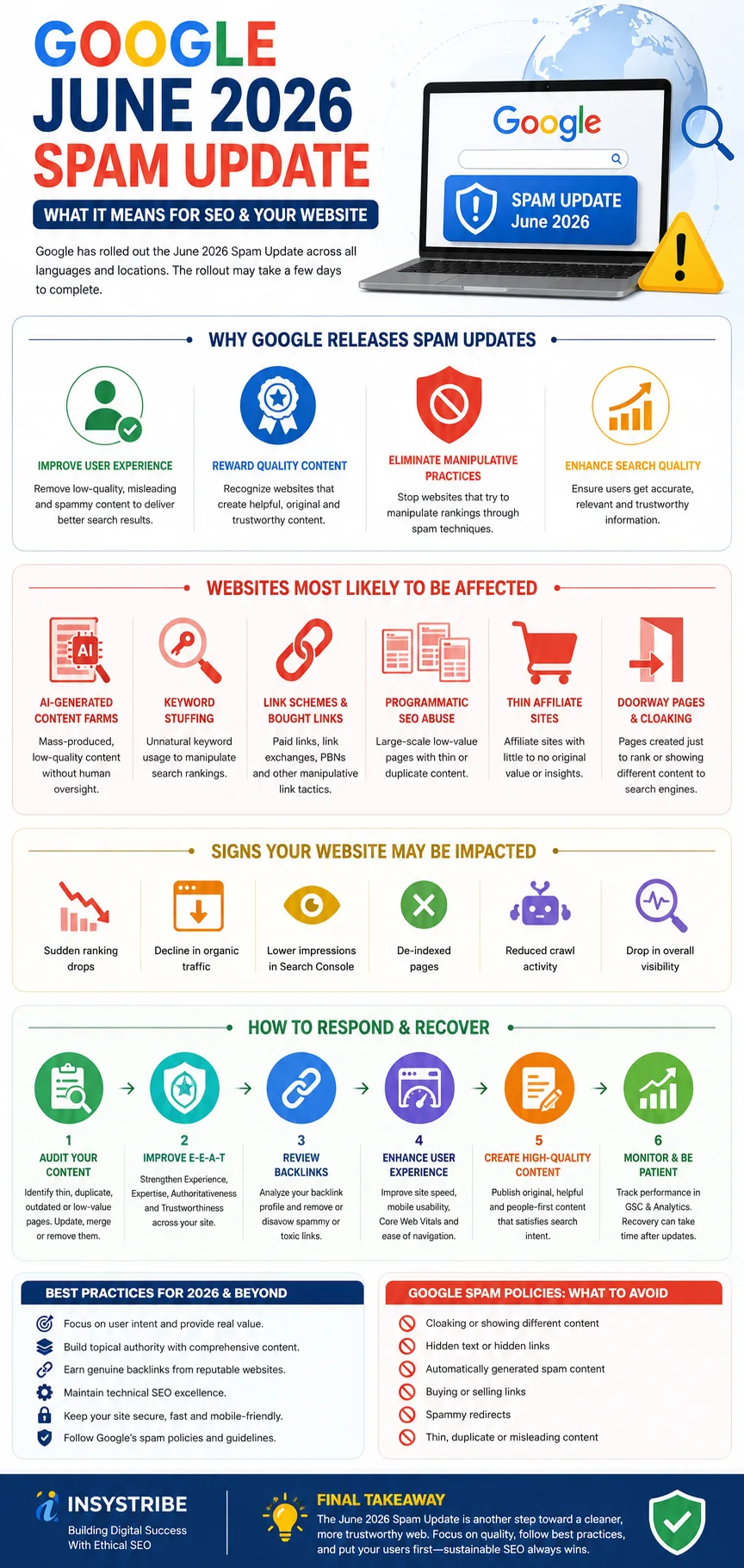
Why Google Releases Spam Updates
Google processes billions of searches daily. To maintain trust, it must ensure that low-quality and manipulative websites do not outrank genuinely useful content.
Spam updates help Google:
Improve User Experience
Users expect accurate information. Spammy websites often provide poor experiences, misleading information, or excessive advertisements.
Reward Quality Content
Google wants businesses that invest in valuable content and user experience to receive the rankings they deserve.
Eliminate Manipulative SEO Practices
Some websites attempt to exploit ranking signals through artificial means. Spam updates reduce the effectiveness of such tactics.
Enhance Search Quality
By removing spam, Google improves overall search result quality and user satisfaction.
Websites Most Likely to Be Affected
Although Google does not reveal every detail of its spam detection systems, historical updates suggest certain websites are more vulnerable.
1. AI-Generated Content Farms
Google does not penalise AI content simply because it is AI-generated. However, websites publishing thousands of low-quality articles without human oversight may face ranking declines.
Common issues include:
- No expertise
- No originality
- Repetitive content
- Factually inaccurate information
- Mass-generated pages
Businesses relying solely on automation without editorial review may experience visibility losses.
2. Websites Using Keyword Stuffing
Keyword stuffing remains one of the oldest spam tactics.
Examples include:
- Repeating keywords unnaturally
- Over-optimised headings
- Excessive keyword usage in anchor text
- Forced keyword placement
Google's systems can easily detect unnatural keyword patterns.
3. Websites Buying Links
Backlinks remain a strong ranking factor, but manipulative link-building practices violate Google's guidelines.
Examples include:
- Paid backlinks
- Private Blog Networks (PBNs)
- Automated link creation
- Link exchanges
- Spam guest posting
Websites heavily dependent on artificial links may see ranking fluctuations.
4. Programmatic SEO Sites
Programmatic SEO can be highly effective when executed correctly. However, websites creating thousands of low-value pages with minimal unique content may be at risk.
Examples:
- City pages with duplicate content
- Auto-generated service pages
- Mass-produced location pages
- Thin affiliate pages
Google increasingly targets large-scale, low-value content generation.
5. Affiliate Websites with No Added Value
Affiliate websites that simply copy product descriptions and provide little unique insight often struggle during spam updates.
Google prefers content that includes:
- Real product testing
- Expert analysis
- Comparisons
- User experience
- Original images
Signs Your Website Has Been Impacted
After a spam update rollout begins, website owners should monitor performance carefully.
Key warning signs include:
Sudden Ranking Drops
Significant keyword ranking losses across multiple pages.
Traffic Decline
Organic traffic decreases are visible in:
- Google Analytics
- Google Search Console
Reduced Impressions
Search impressions begin declining even if rankings appear stable.
De-indexed Pages
Some pages may disappear entirely from search results.
Lower Crawl Activity
Google may reduce crawling frequency on low-quality websites.
How to Check If Your Website Was Affected
Google Search Console
Monitor:
- Performance Report
- Search Clicks
- Impressions
- Average Position
Look for unusual changes beginning around the update rollout period.
Analyse Traffic Patterns
Compare:
- Last 7 days
- Last 30 days
- Previous months
Focus on:
- Organic traffic
- Landing pages
- Keyword performance
Track Keyword Rankings
Use tools such as:
- Ahrefs
- SEMrush
- SE Ranking
- Rank Tracker
Look for widespread ranking volatility.
Google's Main Spam Policies
To stay safe from future updates, businesses should understand Google's spam policies.
Avoid Cloaking
Showing different content to users and search engines violates Google's guidelines.
Avoid Hidden Text
Text hidden through styling or CSS solely for ranking purposes is considered spam.
Avoid Doorway Pages
Creating multiple pages targeting slight keyword variations without a unique value is risky.
Avoid Automatically Generated Spam
Pages generated without meaningful human contribution can trigger spam signals.
Avoid Link Manipulation
Building links solely to manipulate rankings violates Google's policies.
Impact on Local SEO
The June 2026 Spam Update could significantly impact local businesses.
Affected local SEO tactics may include:
- Fake business listings
- Keyword-stuffed business names
- Spam citations
- Fake reviews
- Duplicate location pages
Local businesses should focus on authenticity and user experience.
Impact on E-commerce Websites
E-commerce websites often face unique spam-related challenges.
Common risks include:
Duplicate Product Descriptions
Using manufacturer-provided content without customisation.
Thin Category Pages
Category pages lacking useful information.
AI-Generated Product Content
Mass-produced descriptions with little uniqueness.
Low-Quality Reviews
Fake or incentivised reviews.
How Businesses Should Respond
If rankings decline after the update, avoid panic.
Google recommends focusing on long-term improvements.
Step 1: Conduct a Content Audit
Review:
- Blog posts
- Service pages
- Landing pages
- Product pages
Identify:
- Thin content
- Duplicate content
- Outdated information
Step 2: Improve E-E-A-T
Google increasingly values:
Experience
First-hand knowledge and real-world expertise.
Expertise
Demonstrated subject matter understanding.
Authoritativeness
Recognition within the industry.
Trustworthiness
Reliable and accurate information.
Include:
- Author profiles
- Credentials
- Case studies
- Testimonials
Step 3: Remove Low-Quality Pages
Not every page deserves indexing.
Consider:
- Updating
- Consolidating
- Removing
Weak pages that provide little value.
Step 4: Review Backlink Profile
Analyze backlinks for:
- Spam domains
- Toxic links
- Link schemes
Focus on earning natural, editorial links from authoritative websites.
Step 5: Improve User Experience
Google increasingly rewards positive user experiences.
Optimize:
- Mobile usability
- Page speed
- Core Web Vitals
- Navigation
- Accessibility
SEO Strategies That Work in 2026
As spam detection becomes more advanced, sustainable SEO practices matter more than ever.
Publish Original Content
Create content based on:
- Real experience
- Research
- Industry insights
- Customer questions
Build Topical Authority
Cover topics comprehensively rather than creating isolated articles.
Example:
Instead of one SEO article, create clusters around:
- Technical SEO
- Local SEO
- Ecommerce SEO
- Content Marketing
- Link Building
Focus on Search Intent
Understand what users actually want when searching.
Create content that directly satisfies that intent.
Earn Genuine Backlinks
Effective methods include:
- Digital PR
- Guest posting on quality sites
- Industry partnerships
- Data-driven content
Improve Website Trust Signals
Include:
- Contact information
- Privacy policy
- Terms of service
- Secure HTTPS
- Customer reviews
What SEO Agencies Should Tell Clients
SEO agencies should prepare clients for ranking fluctuations during rollout periods.
Key messages include:
Don't Make Immediate Changes
Wait until rollout completion before drawing conclusions.
Monitor Performance Daily
Track rankings, traffic, and impressions.
Focus on Quality
Avoid reactive SEO tactics.
Think Long-Term
Google updates increasingly reward sustainable SEO practices.
What This Means for Insystribe Clients
At Insystribe, we believe algorithm updates are opportunities rather than threats.
Websites built on:
- High-quality content
- Technical SEO excellence
- User-focused design
- Ethical link building
- Strong E-E-A-T principles
typically perform better over time.
Our SEO approach prioritises sustainable growth rather than short-term ranking tricks, helping businesses maintain visibility through algorithm updates.
Whether you operate an e-commerce store, local business, SaaS company, healthcare website, real estate platform, or enterprise brand, adapting to Google's quality standards remains the most effective long-term strategy.
Final Thoughts
The Google June 2026 Spam Update reinforces a trend we've seen for years: Google continues to reward quality and penalise manipulation.
Businesses relying on spam tactics, low-value AI content, purchased backlinks, or thin pages may experience ranking declines. On the other hand, websites focused on user value, expertise, trustworthiness, and genuine content creation are more likely to benefit.
The best defence against future updates is simple:
Create valuable content, serve users first, follow Google's guidelines, and invest in sustainable SEO practices.
As the rollout progresses, continue monitoring your website's performance through Google Search Console and Analytics. If rankings fluctuate, focus on long-term improvements rather than quick fixes.
The future of SEO belongs to websites that genuinely help users—and Google's June 2026 Spam Update is another step toward that vision.